
Have you ever read an article, listened to a song, or watched a video and wondered how it was created so perfectly? Creativity has always been a human strength, but today, machines are learning how to create too. This shift is powered by Generative Artificial Intelligence, often called Generative AI.
Gen AI is changing how we write, design, build software, and even make decisions. But what exactly is it, and why does it matter?
How AI Can Create Text, Images, and Music
Gen AI is a type of artificial intelligence that creates new content instead of just analyzing existing data. It can generate text, images, music, videos, and code by learning patterns from large datasets.
Traditional AI systems focus on tasks like classification and prediction. For example, identifying spam emails, detecting fraud, or forecasting weather. Generative AI goes a step further, it produces something new that didn’t exist before.
Think of it this way:
- Traditional AI answers: “What is this?”
- Generative AI answers: “What can I create?”
A Simple Way to Think About It
Imagine talking to a very well-read friend. When you ask a question, they don’t search the internet in real time. Instead, they rely on everything they’ve learned before to respond in a meaningful way. Gen AI works in a similar manner.
When you provide a prompt, the model analyzes it, understands context, and predicts the most relevant output based on learned patterns. The technology behind it is complex, but the interaction feels natural.
How Is Generative AI Different from Traditional AI?
Traditional AI is excellent at recognizing patterns. It can:
- Label images
- Categorize text
- Predict outcomes
Generative AI is designed for creation. It can:
- Write articles and emails
- Generate realistic images
- Compose music
- Create software code
This shift from recognition to creation opens new possibilities across industries.
Examples of AI in Action Across Industries
Generative AI is no longer experimental, it’s already being used in real life.
1. Content Creation & Writing
Blog posts, product descriptions, email drafts, and summaries can be generated in seconds. Writers use it as a co-pilot to improve speed and consistency.
Example: Marketing teams use generative AI to draft campaigns while humans refine tone and messaging.
2. Software Development
Developers use generative AI to:
- Write boilerplate code
- Explain complex logic
- Debug errors faster
This helps teams focus more on architecture and problem-solving instead of repetitive tasks.
3. Design & Creative Media
From AI-generated illustrations to video backgrounds and music, generative AI is helping designers prototype faster and explore ideas creatively.
4. Customer Support & Chatbots
AI-powered assistants can handle customer queries, provide instant answers, and escalate complex issues to humans, improving response time and user experience.
5. Education & Learning
Students and professionals use generative AI to:
- Summarize topics
- Explain concepts in simple language
- Generate practice questions
How Does Gen AI Work (At a High Level)?
At its core, generative AI is trained on massive datasets. During training, it learns relationships between words, images, or sounds. Over time, it builds an internal representation, often called a latent space, that helps it understand context and structure.
When a user provides a prompt, the model uses this internal knowledge to generate a response that fits the request. Feedback from users helps refine accuracy and usefulness over time.
You don’t need to understand the math to benefit from it, but knowing what it can and cannot do is key.
Why Gen AI Matters
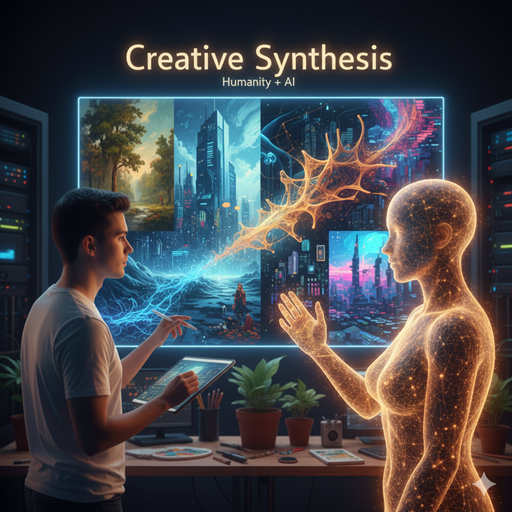
Generative AI is not about replacing humans. It’s about augmenting creativity and productivity. When used responsibly, it becomes a powerful tool that helps people work smarter, explore ideas faster, and focus on higher-value thinking.
As this technology continues to evolve, understanding its fundamentals will be essential, not just for developers, but for anyone working in a digital world.

Looking Ahead: The Creative Future with AI
Generative AI is more than a technological trend, it’s a tool that expands human creativity. By learning patterns from data, it can help us write, design, compose, and solve problems in ways we couldn’t imagine before.
At Evolora, we see generative AI as a partner rather than a replacement. It allows us to focus on the ideas that matter most, while the AI handles repetitive or time-consuming tasks. As this technology evolves, understanding its capabilities will help you harness it effectively, responsibly, and creatively.
The journey has just begun, and the possibilities are limitless.
Learn more about AI that creates text, images, and music

Kaustubh Pandey is the creator of Evolora, a technology professional with a strong interest in modern software systems, cloud platforms, and continuous learning.
Evolora was created as a personal knowledge-sharing initiative to document learning, explore new technologies, and present technical concepts in a simple and practical manner.
Through Evolora, the aim is to create helpful, meaningful content that supports learning and understanding in the ever-changing world of technology.
Leave a Reply