
We’ve all spent the last year marveling at how well AI can talk. We ask a question, and it gives us an answer. But as we move further into the decade, the conversation is shifting. We are moving away from passive chatbots that merely “know” things and toward Action-Driven AI Agents that actually execute tasks.
If you’ve been hearing the word “Agent” buzzing around tech circles and wondered what the hype is about, you’re in the right place. Building a basic AI agent is simpler than you might think, and it represents the next giant leap in how we interact with technology.
How to Build AI Agents: The Three Core Components
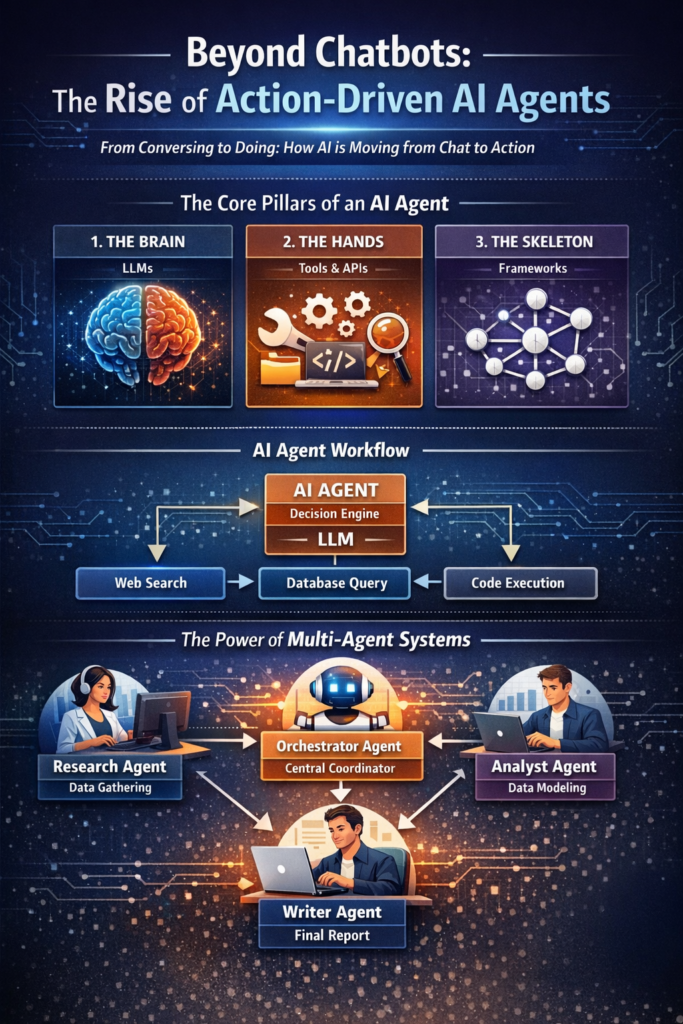
To understand an AI agent, think of it as a digital employee rather than a search engine. According to the sources, a functional, action-driven agent is built on three fundamental pillars:
1. The Brain: Choosing Your LLM
Every agent needs a “brain” to process information and make decisions. This is where Large Language Models (LLMs) come in. You can use any model that fits your budget or needs-whether it’s GPT, Gemini, Claude, or DeepSeek. The brain’s job is to take your instructions and determine the logical steps required to complete a specific task.
2. The Hands: Integrating Tools & APIs
A brain without hands can think, but it can’t act. In the world of Action-Driven AI Agents, “tools” are the hands. These are not physical tools but rather functions, API calls, or connections to MCP (Model Context Protocol) servers. These tools allow the agent to perform specific actions such as:
- Conducting real-time web searches.
- Performing deep research.
- Writing and executing code.
3. The Skeleton: AI Frameworks (LangGraph/CrewAI)
To make the brain and the tools work together, you need a framework. Think of this as the skeleton that connects everything. Two of the most popular frameworks used today are LangGraph and CrewAI. These frameworks allow you to define which LLM to call, which tools to provide, and-most importantly-the context of the mission.
The Importance of Context: Giving Your Agent a Mission
Building an agent isn’t just about the code; it’s about the Prompt. To make an agent effective, you must provide a comprehensive prompt that acts as the “context” for its work. You define exactly what the agent needs to achieve, hand it the tools it needs, and the LLM orchestrates the execution to work for you.
(Expert Insight: From an AI perspective, the quality of your prompt determines whether an agent acts like a junior intern or a senior specialist. Clear constraints and objectives are the keys to autonomous success.)
Scaling Up: Multi-Agent Systems and Orchestration
While a single agent is powerful, it has limits. For complex enterprise-level problems, we use Multi-Agent Systems. Imagine you want to perform a comprehensive stock market analysis. Rather than one agent doing everything, you build a team of specialized, action-driven agents:
- The Researcher: An agent dedicated to scouring news and financial reports.
- The Analyst: An agent that performs complex calculations and data modeling.
- The Writer: An agent that takes all that data and formats it into a professional summary.
To make these agents work together, you need an Orchestrator Agent. This master agent manages the flow of information between the specialized agents, often using tools like the Google SDK for seamless agent-to-agent communication.
Conclusion: The Future of Autonomous AI
The shift toward Action-Driven AI Agents is more than just a technical trend; it’s a paradigm shift in productivity. We are moving toward a world where we no longer “use” software, but rather “delegate” to it. Whether it’s automating your personal finances or building a research department for your business, the building blocks – Brains, Tools, and Frameworks – are already here.
The barrier to entry has never been lower. With the right framework and a clear prompt, you can start building basic agents today. As these agents become more interconnected and autonomous, the only limit will be the creativity of the person giving the instructions.

Kaustubh Pandey is the creator of Evolora, a technology professional with a strong interest in modern software systems, cloud platforms, and continuous learning.
Evolora was created as a personal knowledge-sharing initiative to document learning, explore new technologies, and present technical concepts in a simple and practical manner.
Through Evolora, the aim is to create helpful, meaningful content that supports learning and understanding in the ever-changing world of technology.